

I’ve been having some really interesting chats with a friend and client recently about boundaries—why they matter, the kinds we have with ourselves and others, and how we establish them. We talked about the different areas of life where they show up. For me personally, I’m currently working with boundaries around financial organisation and better sleep.
In that conversation, I found myself explaining why boundaries are also important in movement—especially if we’re experiencing pain. So here’s my attempt to explore what movement boundaries are, why they matter, and how a positive self-narrative around them can make a real difference.
If you’re new to this work, you might want to start with my guide to what the Feldenkrais Method is, which explains how awareness and learning help us move with more ease and less effort.
Take a moment to think about the kind of boundaries we might give a child.
I’m not a parent, but a few come to mind:
No fingers in plug sockets
Bedtime routines
Bath time
Limiting screen time and sugar
Why do we give children these boundaries? For the same reason we benefit from them as adults—to keep us safe and support our well-being. We want children to be well-rested and well-fed so they can learn, stay calm, and enjoy their day.
I’m currently working—with the help of said friend—on setting boundaries that don’t feel like punishment: bed by 10 p.m., fewer sweet treats, a monthly budget.
For me, it’s easy to see boundaries as restrictive. The self-talk often focuses on what’s being taken away—rather than what’s gained: better sleep, steadier energy, or more financial security.
That’s the shift I’m working on. Boundaries aren’t punishment—they’re support.
So, how does this concept relate to Feldenkrais or movement classes?
In the Feldenkrais Method, movement boundaries help create the right conditions for learning. Rather than pushing through discomfort, we work within a range that feels safe and manageable.
This links closely to movement habits—noticing what we do, and choosing when to continue and when to change.
When it comes to movement, I tend to see boundaries show up in two main ways:
1. In class – taking pauses, using props, and not doing every variation
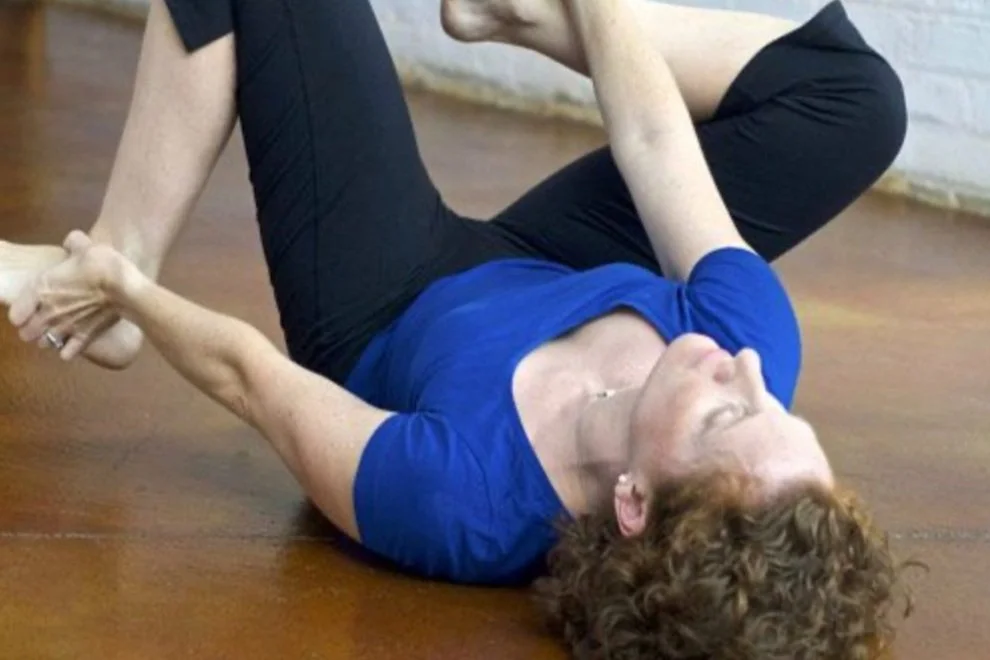
In a Feldenkrais lesson, we’re often given unusual—and sometimes complex—movement puzzles. It can feel a bit like a game of Twister.
If, like me, you have physical limitations, doing every variation may not support your improvement. It’s a healthy movement boundary to not do everything.
I often say my best students are the “worst”—because they don’t always do exactly what I say. And that’s a good thing.
We’re all different. Some movements will suit you, others won’t. Being able to recognise your limits and respond to them is a sign you’re developing awareness and good movement boundaries.
The goal is to stay safe, comfortable, and in the best state for learning.
When to go, when to stop, when to modify…
Should you use a head pad? More padding? Less? Something behind the knees? Slower? Smaller?
It’s a lot to organise, and yes—it can feel frustrating. But these boundaries are there to support you. Not every part of a lesson will suit everyone. Sometimes it’s about finding the closest, most comfortable version of a movement rather than doing it “perfectly.”
And that’s the point of the Method—to engage with the process. Not to perform perfectly, but to learn something about how you move.
Another good reason not to be good at it.
2. Working with physical constraints to isolate areas of the body that don’t move enough
Some people—especially those in pain—have too much movement in one area and not enough in another.
For example, lots of movement in the lower back and not enough in the hips. The lower back ends up doing the work the hips could be doing—often leading to tight hips and a strained back.
One way to work with this is to introduce a temporary boundary (or “constraint”) to limit movement in the overused area. This encourages other parts—like the hips—to become more involved.
When movement is reintroduced, the brain has more options. The work is shared more evenly, and movement becomes easier.
Overtraining can create similar issues—overusing some areas while others become less involved.
Boundaries are:
SELF-CARE
LEARNING
GETTING TO KNOW YOURSELF
FEELING GOOD
BIG-PICTURE THINKING (NOT INSTANT GRATIFICATION)
KNOWING WHEN TO STOP
Boundaries require:
SELF-WORTH
LEARNING
PATIENCE
MODERATION
KINDNESS
How to Set Movement Boundaries
Practise and train your powers of Interoception. - Practices like Meditation and Feldenkrais help you notice your habits and patterns. (Read more here: interoception)
Document or journal your learning from classes.
Writing things down helps reinforce what you’re noticing.
Have lots of props around you.
Cushions, head pads, rollers—experiment and find what supports you.
Don’t do everything you’re told.
Listen to your teacher—but also to yourself.
Be patient with yourself.
Learning isn’t linear. Small, steady improvements make a big difference.
As always, thank you for reading. I hope these thoughts offer some reassurance and support in your well-being.
Move well,
James