
How Many Feldenkrais Sessions Do I Need?
Often when I'm meeting with a client initially, or after their first couple of sessions, a regular question I get asked is:
“How many sessions do I need?”
It’s a very good question. It’s also one that is surprisingly difficult to answer.
If you’re investing your time and money in something, it makes complete sense to want to know where you’re going and how long it might take to get there.
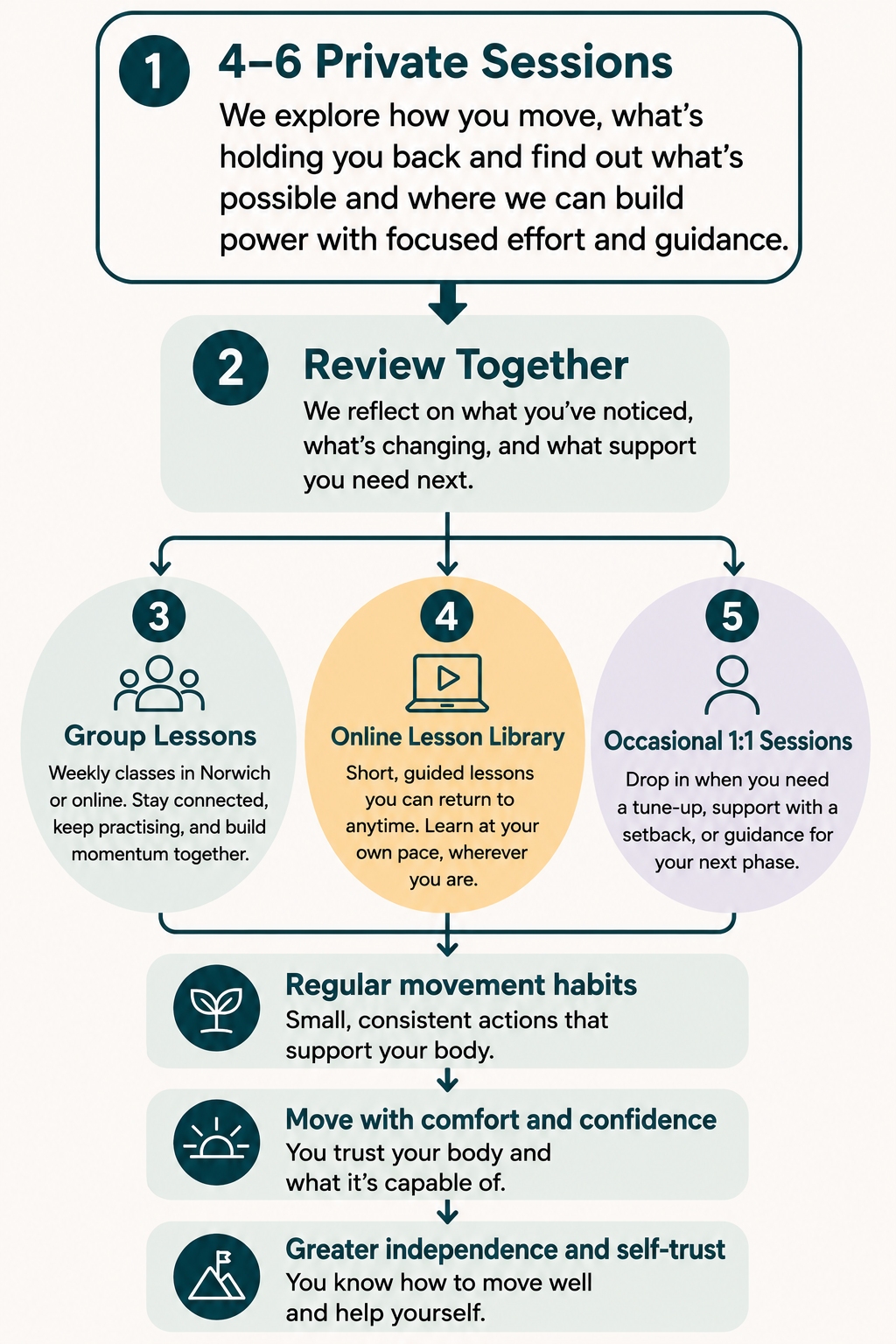
So, if you asked me for a number, I would usually say four to six sessions when you’re starting out.
But that number comes with a big caveat.
There is no standard number of Feldenkrais lessons that everyone needs.
Everyone learns differently
Feldenkrais is a learning process, and we all learn at different rates.
Where you’re starting from matters. What you’re hoping to change matters. Your history, your habits, your relationship with your body and the particular challenges you’re experiencing all form part of the picture.
That means that the work we do together is not a standard programme where everyone follows the same sequence of lessons.
We are mapping out a very individual journey.
Four to six sessions might be enough for someone to develop a new awareness and feel ready to explore more independently. Someone else might benefit from continuing one-to-one work for longer.
And that brings me to a slightly different way of asking the question.
Perhaps the question isn't:
“How many sessions do I need?”
Perhaps it's:
“At what point will I feel able to learn more independently?”
The goal isn't for you to need me
One of the things I love most about the Feldenkrais Method is that the ultimate goal isn't dependence on the practitioner.
Quite the opposite.
The work is about developing your own ability to notice, understand and make choices about yourself.
Moshe Feldenkrais described this as developing “mature behaviour”. I don't particularly love that phrase today because it can sound as though there is a particular level of maturity that you are supposed to reach.
What I think he was pointing towards was something much more useful:
the ability to act independently, with awareness and choice.
Rather than always needing someone else to tell you what to do, you begin to understand yourself well enough to make your own decisions.
First, you have to feel what you're doing
This is one reason the one-to-one work can be so valuable.
Many of our movement habits are outside our conscious awareness.
You might know that your shoulder hurts, for example, but not realise how much you habitually tighten your jaw when you move your arm.
You might know that your back feels uncomfortable, but not notice that you consistently shift your weight onto one leg when you stand.
Knowing that something happens isn't necessarily the same as knowing how it happens.
And you can't always think your way into that understanding.
Sometimes you have to feel it.
In Functional Integration®, I use gentle hands-on contact to help you sense how you organise yourself in movement: where you are in space, how you distribute your weight, how different parts of you relate to one another, and where you might be using effort that isn't necessary.
It's a non-verbal conversation.
Rather than telling your conscious mind what it should be doing, we're giving your nervous system an opportunity to experience something different.
The learning doesn't stop when you leave
Your lessons don't only happen when you're lying on the table.
During a series of sessions, I'll often give you what we might loosely call homework.
But this isn't homework in the traditional sense.
I'm not going to send you home with an exercise sheet and tell you to perform ten repetitions of something every morning.
Your homework is really about becoming more aware.
I might ask you to notice how you get in and out of a chair. How you walk. What happens to your breathing when you're concentrating. Do you stop breathing when you start lifting something heavy? What happens when you're lifting weights at the gym? How do you organise yourself when you're tired, stressed or in a hurry?
These are small invitations to pay attention to how you actually do things in your everyday life.
Because this is where the learning starts to become useful.
The lessons we explore together aren't separate from your life. They're there to be integrated into it.
And that's actually what Functional Integration® is pointing towards: bringing the learning from our one-to-one lessons into the functions of your everyday life.
The more you notice, the more opportunities you have to make different choices.
And the more invested both of us are in that process, the more quickly learning can happen.
From being guided to discovering for yourself
Over time, something begins to change.
You start to recognise your own patterns.
You might suddenly notice:
“Ah. I'm doing that thing again.”
And that moment is important.
Because once you can recognise a pattern, you have the possibility of making a different choice.
That's when the work can begin to move from:
“Help me change this.”
towards:
“I can feel what I'm doing. What else could I do?”
This is where I gradually want to do less for you.
The hands-on work may become less frequent. We might introduce more Awareness Through Movement® lessons. You might join a group class, explore the online library, or begin incorporating what you're learning into activities you already enjoy.
You might take what you've discovered into yoga, Pilates, Tai Chi, walking, dancing, running, gardening or simply getting on with your everyday life.
The learning starts to belong to you.
Your investment isn't only financial
This is why I think it's useful to think about the question of sessions in terms of investment.
Yes, there is a financial investment. If you're starting out, four to six one-to-one sessions might be a useful starting point.
But there is another investment that can have an enormous impact on your learning: your attention.
If you come to your sessions, experience the learning, and then spend the rest of the week going about your life without thinking about it, the process will naturally take its own course.
But if you begin noticing how you move, breathe, sit, stand, walk and respond to everyday situations, you're continuing the learning between sessions.
You're giving yourself opportunities to recognise the patterns we're exploring together.
That can make a significant difference.
The more actively you participate in the process, the more quickly you may begin to recognise your own habits — and the sooner you may feel able to work independently.
“When you know what you are doing, you can do what you want.”
This is one of the most famous Feldenkrais ideas, and I think it captures the point beautifully.
The aim isn't to give you a list of things you should do.
It's to help you become curious about what you are already doing.
Because when you can sense your habits, you have more choice.
And when you have more choice, you have more possibilities.
That's why I don't really want you to become dependent on having a weekly appointment with me forever.
I'd much rather you reached a point where you could notice something for yourself and think:
“I know what I'm doing here.”
Then:
“What else is possible?”
And perhaps you don't need me to answer that question.
Perhaps you can begin exploring it yourself.
So, how many sessions do you need?
If you're completely new to one-to-one Feldenkrais work, four to six sessions is a useful place to start.
It gives us enough time to get to know how you move, begin to uncover some of your habitual patterns and start developing your ability to sense yourself more clearly.
But there is no magic number.
You might decide after four sessions that you have learned what you need and feel ready to explore independently.
You might want to continue with one-to-one work because there is more you want to discover.
Or you might move between the two: occasional one-to-one sessions alongside group classes and your own independent practice.
There is no right answer.
Perhaps the most useful measure isn't the number of sessions you've completed.
It's how much choice you have.
Can you notice what you're doing?
Can you recognise an old habit when it appears?
Can you pause before automatically doing the same thing?
Can you imagine another possibility?
And can you begin to choose for yourself?
That, to me, is where the real learning begins.
Curious to find out more?
If you're curious about Functional Integration® and how it might be able to help you, feel free to book a complimentary telephone conversation with me.